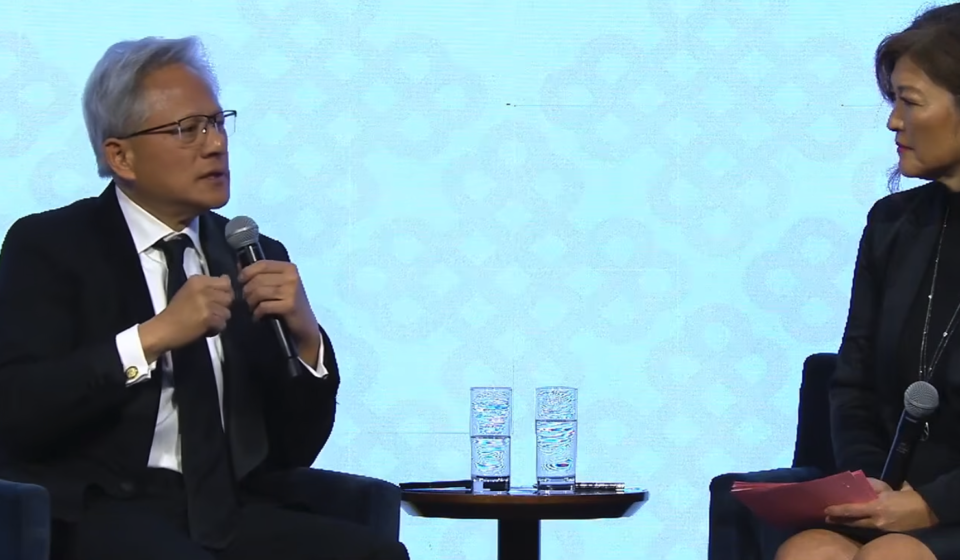

When NVIDIA CEO Jensen Huang stood on stage in New York to accept the prestigious Van Fleet Award, he made a remark that immediately captured attention.
“There’s a little bit of Korean in me.”
The audience laughed.
But what followed was not a joke.
It was a deeply personal reflection on resilience, determination, perseverance, and the ability to endure hardship.
For Jensen Huang, those qualities were not just characteristics he admired in Korea.
They were qualities he believed helped shape his own journey.
And as he accepted one of the most meaningful honors in U.S.–Korea relations, he spent much of the evening talking about a relationship that began nearly three decades ago.
A relationship not simply with Korean companies, but with Korea itself.
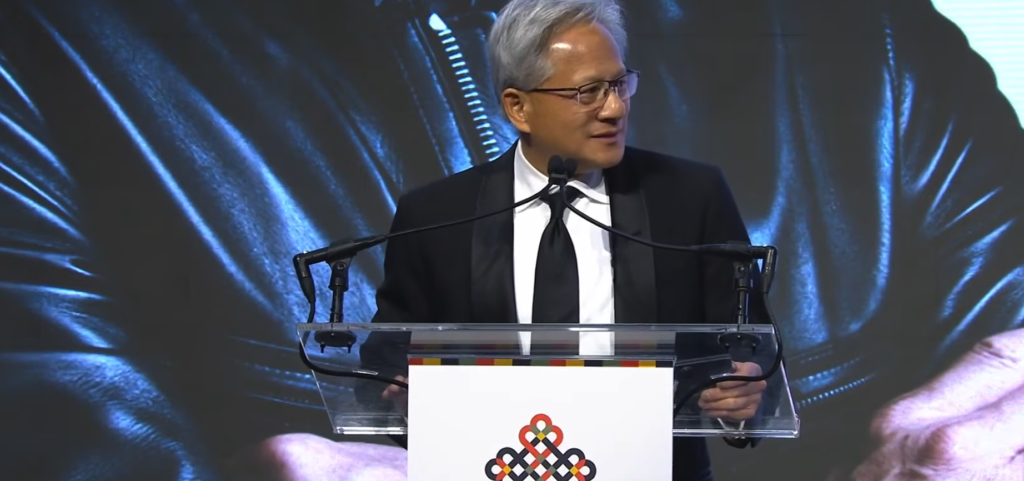
The Meaning Behind the Van Fleet Award
The Van Fleet Award is named after General James Van Fleet, commander of the U.S. Eighth Army during the Korean War.
The award recognizes individuals and organizations that have made significant contributions to strengthening relations between the United States and South Korea.
The list of past recipients is remarkable.
Former U.S. President Jimmy Carter.
Former South Korean President Kim Dae-jung.
Samsung Chairman Lee Kun-hee.
SK Group Chairman Chey Tae-won.
Even BTS.
Each recipient represents a different chapter in the story of the U.S.–Korea partnership.
This year, that chapter belonged to Jensen Huang.
Why the Award Meant So Much to Him
During his acceptance speech, Jensen explained that the award was especially meaningful for three reasons.
The first was gratitude.
Not gratitude for business success.
Not gratitude for technological achievements.
But gratitude for friendship.
He told the audience that his relationship with Korea started when he was younger than his own children are today.
For decades, that relationship has continued to evolve.
As Korea transformed itself into one of the world’s leading technology powers, NVIDIA was growing alongside it.
To Jensen, the two stories became intertwined.
A Letter From Lee Kun-hee
One of the most fascinating moments from the evening involved a story many people had never heard before.
Jensen revealed that one of his earliest visits to Korea happened after receiving a letter from Samsung Chairman Lee Kun-hee.
At the time, Lee had a vision for Korea’s technological future.
He wanted Korea to become a leader in broadband internet.
He wanted digital entertainment to flourish.
He wanted Korea to become a center of innovation.
For a young NVIDIA, this vision mattered.
And so Jensen came to Korea.
What he found would leave a lasting impression.
The Korea of PC Cafés and StarCraft
To understand Jensen Huang’s connection to Korea, it’s important to remember what Korea was becoming during the late 1990s.
This was the era of ultra-fast internet.
The era of PC cafés.
The era of StarCraft.
Few countries embraced online gaming the way South Korea did.
For many young Koreans, gaming was not just entertainment.
It was culture.
It was community.
It was competition.
As Jensen visited electronics markets and met Korean consumers, he noticed something extraordinary.
People knew NVIDIA.
They were passionate about its products.
More importantly, they cared about technology in a way he had rarely seen anywhere else.
The Moment He Fell in Love With Korea
Jensen recalled hearing NVIDIA’s name chanted aloud by Korean gamers.
For a founder, it was an unforgettable experience.
He described it as one of the first times he truly understood the impact his company was having in the real world.
The reaction took his breath away.
And according to him, it became impossible not to fall in love with Korea.
That affection has continued for nearly thirty years.
From Gaming to Artificial Intelligence
At the time, NVIDIA was primarily known for graphics processors.
Today, it sits at the center of the global AI revolution.
Yet many of the partnerships that helped shape the company’s journey began during those early years.
Samsung memory chips appeared in NVIDIA products long before AI became a global obsession.
Those relationships evolved over decades.
What started with PC gaming eventually became part of the infrastructure powering artificial intelligence.
This long history explains why Jensen often talks about Korea not simply as a business partner but as a country that helped shape NVIDIA’s story.
Why Jensen Huang Believes Korea Has a Unique AI Advantage
During a discussion at the event, Jensen was asked a straightforward question:
What can Korea contribute to the future of AI?
His answer surprised many people.
He did not begin by talking about semiconductors.
He did not begin by talking about manufacturing.
And he did not begin by talking about government policy.
Instead, he talked about culture.
According to Jensen, one of Korea’s greatest strengths is its enthusiasm for technology.
He pointed out that throughout history, many breakthrough technologies were invented in one place but transformed society somewhere else.
To explain this idea, he referenced the Industrial Revolution.
Scientists such as Maxwell, Volta, and Ampere laid the foundations of modern electrical technology in Europe.
Yet it was the United States that ultimately applied those technologies across entire industries and transformed them into economic power.
Jensen believes Korea possesses something special.
It has both the ability to develop advanced technology and the willingness to adopt it quickly.
That combination, he argued, gives the country a significant advantage in the AI era.
Korea Has One Problem AI Can Help Solve
Jensen also discussed one of Korea’s biggest challenges.
Population.
South Korea faces one of the lowest birth rates in the world.
A shrinking workforce creates pressure on economic growth, productivity, and long-term competitiveness.
For many countries, this would be viewed purely as a crisis.
Jensen sees something different.
He sees an opportunity.
According to him, AI and automation may allow countries to achieve far more than their population size would normally allow.
In other words, a nation does not necessarily have to be large to compete at the highest level.
With powerful AI systems, automation, and advanced infrastructure, smaller countries can operate well above their traditional weight class.
As he explained, Korea now possesses technologies that previous generations could only dream about.
For the first time, demographic limitations may no longer define a nation’s future in the same way they once did.
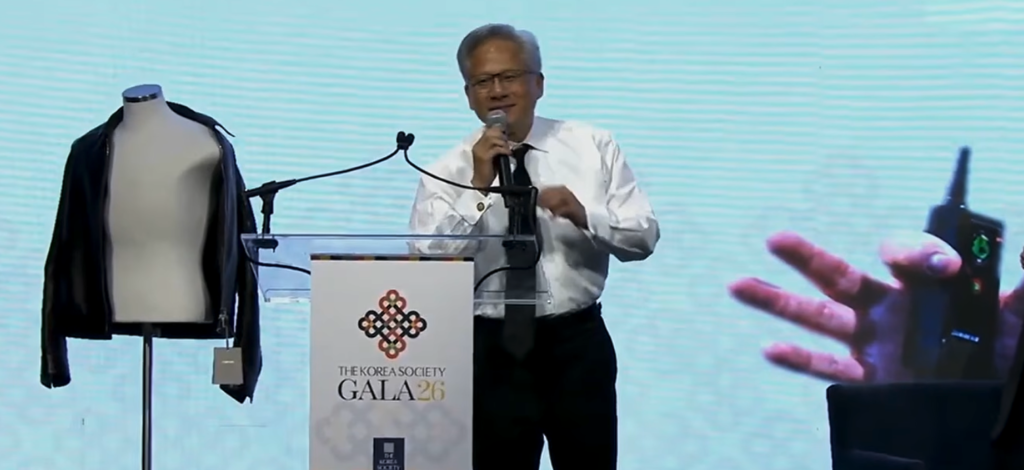
Korea’s Biggest Strength May Be Its Mindset
Jensen repeatedly emphasized a point that has appeared in many of his public remarks about Korea.
Koreans are not afraid of new technology.
Whether discussing broadband internet in the 1990s, online gaming in the 2000s, smartphones in the 2010s, or AI in the 2020s, Korea has consistently adopted new technologies quickly.
This willingness to experiment creates powerful advantages.
Many societies move cautiously.
Some remain skeptical.
Others take years to adapt.
Korea, however, often embraces technological change with remarkable speed.
According to Jensen, that mindset alone gives Korea a significant head start as artificial intelligence becomes a defining technology of the coming decades.
“You’re a Rockstar in Seoul”
One of the lighter moments of the evening came when the interviewer jokingly told Jensen:
“You’re basically a rockstar in Seoul.”
The audience laughed.
But the comment was not entirely exaggerated.
Over the last few years, Jensen Huang has become one of the most recognizable technology figures in South Korea.
His visits regularly generate enormous attention.
Restaurants he visits become local attractions.
Photos circulate rapidly online.
And every meeting with major Korean business leaders becomes national news.
One particularly famous example was the so-called “Kkanbu Meeting,” where Jensen met Samsung Chairman Lee Jae-yong and Hyundai Motor Group Chairman Chung Euisun for fried chicken and beer in Seoul.
The event became so popular that the restaurant reportedly experienced a surge of visitors afterward.
For many Koreans, Jensen is not simply the CEO of NVIDIA.
He represents the center of the global AI industry.
The Unexpected Connection Between Jensen and Lee Jae-yong
Samsung Chairman Lee Jae-yong also delivered remarks during the event.
His speech mixed humor with personal anecdotes.
One story immediately caught the audience’s attention.
Lee revealed that both he and Jensen have daughters named Madison.
The discovery reportedly surprised both men.
Lee joked that perhaps their daughters should receive some credit for strengthening the relationship between NVIDIA and Samsung.
Afterward, Lee reminded the audience that his father, Samsung Chairman Lee Kun-hee, had received the same award years earlier.
The remark highlighted how long the relationship between Samsung and NVIDIA has extended across generations.
“We Suffered. We Endured.”
As the discussion turned to Jensen’s personal story, the interviewer asked what had shaped his character.
How did a young immigrant become one of the most influential technology leaders in the world?
Jensen’s answer returned once again to resilience.
He spoke about his parents’ generation.
He spoke about post-war Asia.
He spoke about hardship.
And then, to the delight of many in attendance, he used a Korean expression.
“You worked hard.”
Or more accurately:
“You suffered through difficult times.”
The Korean phrase carries a deeper meaning than a simple acknowledgment of effort.
It recognizes endurance.
Persistence.
Sacrifice.
Jensen explained that many Asian families of his parents’ generation experienced extraordinary hardship.
War.
Poverty.
Economic uncertainty.
Those experiences shaped entire generations.
And according to him, they also shaped his own mindset.
The Secret Behind NVIDIA’s Survival
Today, NVIDIA is one of the most valuable companies in the world.
But its journey was far from easy.
There were periods when the company came dangerously close to failure.
There were years of uncertainty.
Moments when survival itself was not guaranteed.
When asked how NVIDIA managed to endure those difficult periods, Jensen returned to the themes he had discussed throughout the evening.
Resilience.
Stubbornness.
Determination.
The ability to keep moving forward when everything seems impossible.
Those qualities, he said, were deeply familiar to Koreans.
And in many ways, they had become part of him as well.
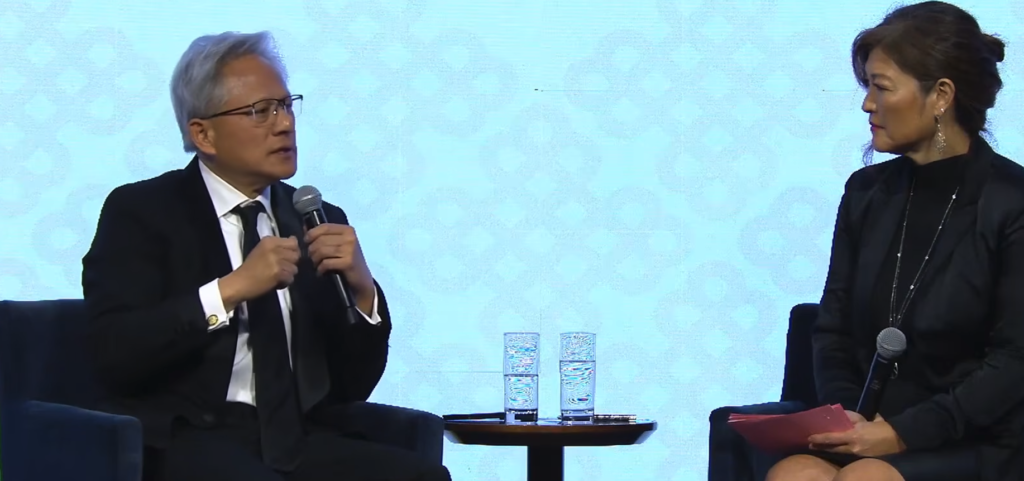
Calling Korea an “Industrial Miracle”
During his acceptance speech, Jensen became even more direct.
He described South Korea as an industrial miracle.
And he emphasized that he was not exaggerating.
When people examine Korea’s transformation over the last several decades, the scale of change is difficult to ignore.
Within a single generation, the country evolved from a developing economy into one of the world’s leading industrial and technological powers.
According to Jensen, very few nations have achieved such dramatic progress in such a short period of time.
What impressed him most was not merely the economic growth itself.
It was the ambition behind it.
The determination to continually improve.
The refusal to accept limitations.
And the belief that something better could always be built.
“Nobody Builds Factories Better Than Koreans”
Perhaps the most memorable line from the evening came near the end of Jensen’s speech.
Discussing the future of AI infrastructure, he made an observation that immediately resonated with the audience.
“Nobody builds factories better than Koreans.”
It was a compliment.
But it was also a statement about Korea’s role in the AI era.
For decades, Korea’s manufacturing capabilities have been recognized globally.
From semiconductors and electronics to automobiles and shipbuilding, Korean companies have developed a reputation for industrial excellence.
Jensen believes the next chapter will involve a different kind of factory.
Not factories producing cars.
Not factories producing televisions.
But factories producing intelligence.
Data centers.
AI infrastructure.
The digital foundations of future economies.
And according to him, Korea is uniquely positioned to help build them.
The Partnership Between NVIDIA, Samsung, and SK
The evening also highlighted the importance of NVIDIA’s relationships with Korean companies.
Samsung.
SK Group.
SK Hynix.
Hyundai.
LG.
Naver.
All were mentioned as part of Korea’s growing AI ecosystem.
These partnerships are particularly critical because AI systems require enormous amounts of memory, computing power, and advanced manufacturing.
When questioned about NVIDIA’s dependence on Korean suppliers, Jensen offered a remarkably confident response.
He said that Korea’s manufacturing capabilities are simply world-class.
And if critical components must be entrusted to someone, he feels comfortable trusting Korean companies.
It was one of the clearest endorsements he has given of Korea’s industrial capability.
“We Worked Together for 33 Years”
Toward the end of his remarks, Jensen summarized the relationship in a way that resonated throughout the room.
He pointed out that NVIDIA and Korea have been working together for more than three decades.
Then he added:
“We have worked together for 33 years.”
“And we will work together for another 33 years.”
The statement was partly symbolic.
But it carried genuine meaning.
Because for Jensen Huang, Korea is not simply a market.
It is not simply a supplier.
It is not simply a business partner.
It is part of NVIDIA’s story.
And as AI becomes one of the defining technologies of the 21st century, he clearly believes that Korea will remain an essential part of its future.
Final Thoughts
At the beginning of the evening, Jensen Huang said there was a little bit of Korean in him.
As the event unfolded, it became clear what he meant.
When he talks about Korea, he often returns to the same qualities:
- Resilience
- Stubbornness
- Determination
- The ability to endure hardship
To him, those characteristics helped transform Korea into an industrial powerhouse.
Those same characteristics helped NVIDIA survive its most difficult years.
And those same characteristics may help define the future of artificial intelligence.
His praise was delivered with humor.
His stories often drew laughter.
But beneath the jokes was something serious.
A deep respect for a country that helped shape NVIDIA’s journey.
A confidence in Korean companies that now sit at the center of the AI revolution.
And a belief that Korea’s true competitive advantage is not only its technology.
It is the people who build it.