How Are Koreans Different from Chinese and Japanese People? Korean History Through Goguryeo Murals and Western Accounts

Have you ever wondered whether Koreans, Chinese people, and Japanese people look alike, or whether there are historical differences between them?
Today, we’ll explore this question through historical accounts written by Western visitors to Korea in the late 19th century, ancient Goguryeo tomb murals, and the history of how the Korean people developed.
Let’s begin with the observations made by Western travelers who visited Korea during the late Joseon period. Some of their writings described Korean people’s appearance, height, body proportions, and facial features.
Certain accounts praised Koreans for their height, balanced physiques, and distinctive appearance. Among the historical figures who wrote about Korea were Ernst Oppert, a German-born traveler, and Isabella Bird Bishop, a British travel writer.
However, these descriptions reflect personal observations as well as the cultural assumptions of their time. They should not be treated as scientific proof that Koreans, Chinese people, and Japanese people have fundamentally different appearances.
So, what did people in ancient Korea look like?
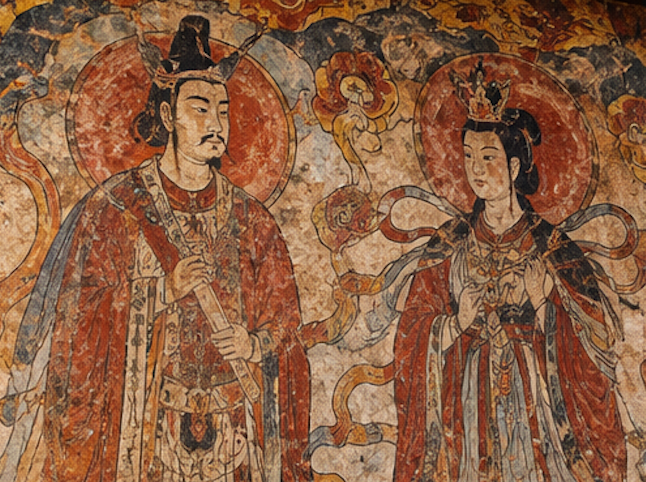
One important source of historical evidence is the tomb murals of Goguryeo, an ancient kingdom that ruled parts of the Korean Peninsula and Manchuria.
Murals preserved in present-day Jilin Province in China and in North Korea depict clothing, daily life, mounted warriors, hunting scenes, and other aspects of Goguryeo society.
The murals of the Five Tombs, including figures identified as the Sun God and Moon Goddess, the paintings at the Anak Tombs, and the hunting scene in the Muyong Tomb provide valuable insights into ancient Korean culture.
The people depicted in these murals display a variety of facial features, hairstyles, and clothing styles.
One particularly fascinating subject is the armored cavalry of Goguryeo. These warriors rode horses equipped with protective armor and were part of a sophisticated military tradition.
Their depictions help us understand Goguryeo’s military development and its connections with neighboring societies across northern East Asia.
Other tombs, including the Three-Chamber Tomb and the Gakjeochong Tomb, also contain figures with different appearances.
The wrestling scene in Gakjeochong, for example, features two men whose facial characteristics have attracted attention from historians and viewers alike.
However, it would be inaccurate to identify someone’s ancestry or geographic origin solely from the size of their nose or the shape of their face in an ancient painting.
Goguryeo developed across parts of the northern Korean Peninsula and Manchuria. Understanding its history therefore requires looking beyond the Korean Peninsula and examining the political and cultural connections that linked different parts of northeastern Asia.
Another fascinating example comes from the Afrasiab archaeological site near Samarkand in present-day Uzbekistan.
Murals discovered at this site depict envoys and people associated with different regions. They provide evidence of diplomatic relations and cultural exchanges between Central Asia and East Asia during the early medieval period.
Some interpretations have connected figures in these murals with Goguryeo envoys. However, identifying particular figures requires careful consideration of historical evidence and scholarly research.
This brings us to another important question: When did the Korean people begin to form as a distinct ethnic community?
The origins of the Korean people cannot be explained by a single event or one ancestral bloodline.
Various communities lived throughout the Korean Peninsula and Manchuria in prehistoric times. Over many centuries, populations migrated, interacted, and influenced one another.
Ancient states such as Buyeo, Goguryeo, Baekje, and Silla developed through a complex network of relationships, conflicts, and cultural exchanges.
Over time, language, culture, political integration, and shared historical experiences contributed to the development of Korean identity.
One important distinction is that ethnicity and genetic ancestry are not the same thing.

Korean identity is not determined solely by biological similarities. It has also been shaped by language, culture, historical experience, and a shared sense of community.
The relationship between Koreans, Chinese people, and Japanese people should be understood in a similar way.
These societies have interacted for centuries, and their populations have been shaped by different patterns of migration, regional history, and cultural development.
There is also considerable individual and regional variation in appearance within all three populations. Facial shape, nose size, or other physical characteristics cannot reliably determine a person’s ethnicity or ancestry.
Ultimately, the Goguryeo murals and the accounts written by Western visitors to Korea offer an important lesson: ancient Korean society was culturally diverse and historically interconnected.
Goguryeo maintained active relationships with neighboring regions to the north, while Korean identity developed gradually through a long and complex historical process.
To understand the origins and appearance of the Korean people, we should look beyond striking historical descriptions or individual facial features. Archaeology, history, and population genetics all contribute important evidence to this discussion.
Thank you for joining me as we explored Korean history, the Goguryeo tomb murals, and the origins of the Korean people.