
A modern look at the industries shaping Korea’s future economy.
Korea is no longer just the land of K‑pop and kimchi.
It’s a global powerhouse in technology, entertainment, and advanced manufacturing.
To understand modern Korea, you need to understand the industries driving its growth—and why the world is paying attention.
This guide breaks down the six sectors that define Korea’s future.
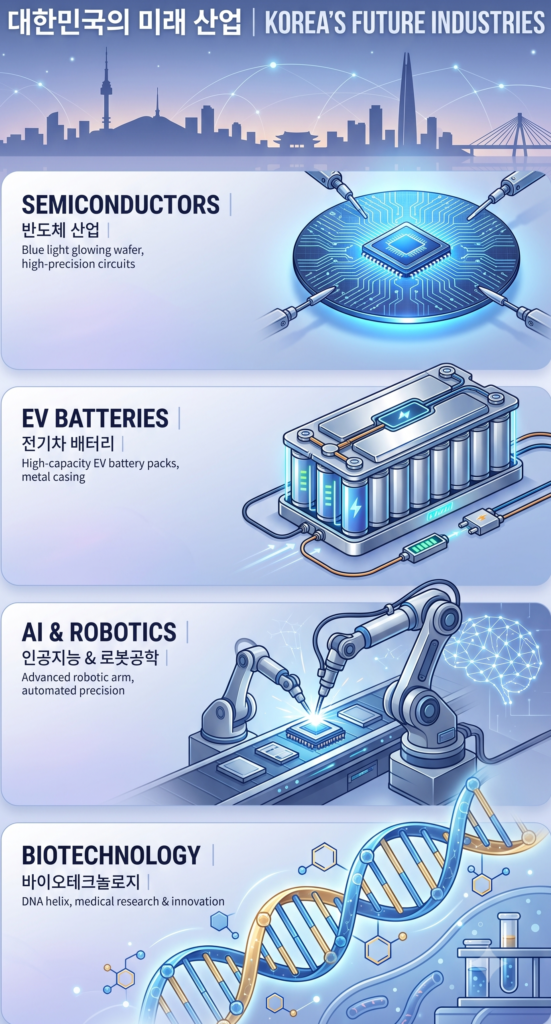
Korea’s key industries at a glance
| Industry | Leading companies | Main hubs |
|---|---|---|
| Semiconductors | Samsung Electronics, SK hynix | Pyeongtaek, Icheon, Yongin, Hwaseong |
| AI & software | Naver, Kakao, LG AI Research, SK Telecom, Upstage | Pangyo, Seoul (Gangnam, Seongsu) |
| EV batteries | LG Energy Solution, SK On, Samsung SDI | Ochang, Cheonan, plus plants in the U.S. and Europe |
| Bio & healthcare | Samsung Biologics, Celltrion, SK Bioscience | Songdo (Incheon), Osong |
| Shipbuilding & defense | HD Hyundai, Hanwha Ocean, Samsung Heavy, Hyundai Rotem | Ulsan, Geoje, Changwon |
| Entertainment | HYBE, SM, JYP, YG, CJ ENM | Seoul |
⚙️ 1. Semiconductors: Korea’s Core Strength
If Korea had a “heart,” it would be semiconductors.
Why semiconductors matter:
- Samsung is the world’s largest memory chip producer
- SK Hynix is a global leader in DRAM and NAND
- Chips power everything: AI, smartphones, EVs, servers
Korea’s advantage:
- Decades of investment
- Massive production capacity
- Strong global partnerships
What’s next:
- High‑bandwidth memory (HBM) for AI
- Advanced packaging
- AI‑optimized chips
Semiconductors are Korea’s most important industry—economically and strategically.
Chips are Korea’s largest export item, and semiconductor exports set a record of about US$142 billion in 2024 — then broke that record again in 2025 on AI demand. The AI boom has made one product especially important: high‑bandwidth memory (HBM), the stacked memory that sits next to AI processors in data‑center servers. SK hynix became a leading HBM supplier for AI chips, while Samsung is racing to expand its share.
The government is also backing a huge semiconductor cluster in Yongin, south of Seoul, and Samsung’s Pyeongtaek campus is one of the largest chip production sites in the world. Interested in how global tech leaders see Korea? Read why Jensen Huang praised Korea’s resilience.
🤖 2. Artificial Intelligence: Korea’s Next Big Leap
Korea is rapidly expanding its AI ecosystem.
Key players:
- Samsung (AI chips, on‑device AI)
- Naver (HyperCLOVA X, enterprise AI)
- Kakao (AI services, conversational AI)
- LG (AI robotics, smart home AI)
Why Korea is competitive:
- Strong hardware + software integration
- Government investment
- AI adoption across industries (finance, retail, healthcare)
Future direction:
- AI semiconductors
- AI robotics
- AI in manufacturing automation
Korea aims to become a top global AI hub.
Korea passed its AI Basic Act in late 2024, one of the first comprehensive AI laws in the world, and it took effect in January 2026. The government is also funding a national project to build Korean‑language foundation models with companies such as Naver, LG and SK Telecom, so that Korea is not fully dependent on foreign AI.
Korea also has one of the highest robot densities in the world — the number of industrial robots per factory worker — which makes it a natural testing ground for AI in manufacturing.
🔋 3. EV Batteries: Korea’s Global Dominance
Korea is one of the world’s top EV battery producers.
Major companies:
- LG Energy Solution
- SK On
- Samsung SDI
Why Korea leads:
- High‑performance lithium‑ion technology
- Strong partnerships with Tesla, Ford, GM, Hyundai
- Massive global factories (U.S., Europe, Asia)
Future trends:
- Solid‑state batteries
- Faster charging
- Longer lifespan
EV batteries are one of Korea’s fastest‑growing export industries.
The industry also faces real challenges. Chinese makers such as CATL and BYD lead the global market with cheaper LFP (lithium iron phosphate) batteries, and EV demand slowed in some markets. Korean companies are responding by building LFP lines, investing in energy storage systems (ESS) for power grids and data centers, and developing next‑generation solid‑state batteries.
🧬 4. Bio & Healthcare: Korea’s Emerging Power
Korea’s bio industry has grown rapidly in the last decade.
Key strengths:
- Biopharmaceutical manufacturing
- Biosimilars
- Vaccine production
- Medical devices
Major companies:
- Celltrion
- Samsung Biologics
- SK Bioscience
Why it matters:
Korea is becoming a global hub for biotech manufacturing and clinical trials.
Songdo in Incheon, near the airport, has grown into one of the world’s largest biopharmaceutical manufacturing clusters. Samsung Biologics produces medicines there for global pharmaceutical companies under contract, and Celltrion is known worldwide for biosimilars — lower‑cost versions of biologic drugs whose patents have expired.
🎵 5. Entertainment: K‑pop, K‑drama, and Global Cultural Influence
Korea’s entertainment industry is not just cultural—it’s economic.
K‑pop:
- BTS, Blackpink, NewJeans
- Massive global tours
- Streaming dominance
K‑drama:
- Netflix partnerships
- Global fandom
- High production quality
Why entertainment matters economically:
- Tourism boost
- Merchandise
- Global branding
- Export revenue
K‑content is one of Korea’s most powerful soft‑power tools. For the cultural side of the story, see our guide to Korean pop culture and Hallyu.
⚓ 6. Shipbuilding & Defense: The Comeback Industries
Korea has long been one of the world’s top shipbuilding nations, and its shipyards in Ulsan and Geoje are famous for building complex vessels such as LNG carriers. Rising demand for cleaner, more advanced ships has given the industry a strong comeback, and Korean shipbuilders are also expanding cooperation with the United States.
Defense has become another major export. Korean equipment such as the K9 self‑propelled howitzer and the K2 tank has been sold to countries including Poland, making “K‑defense” a new word in global news.
🌐 How These Industries Connect
Korea’s rising industries don’t exist separately—they reinforce each other.
- AI needs semiconductors
- EVs need batteries
- Entertainment drives global interest in Korean tech
- Bio benefits from Korea’s advanced manufacturing
- Semiconductors power all digital industries
This interconnected ecosystem is what makes Korea unique.
🧭 Why Foreigners Should Pay Attention
- Korea influences global tech cycles
- Korean companies are major suppliers for U.S. and EU industries
- Korea’s entertainment shapes global culture
- Korea’s EV batteries power the future of transportation
- Korea’s semiconductors drive AI innovation
Understanding Korea’s industries means understanding the future of global technology.
Where to see Korean industry up close
- Samsung Innovation Museum (Suwon): exhibits on the history of electronics and semiconductors. Visits usually require an online reservation.
- Hyundai Motorstudio: car and mobility showrooms in Seoul (Gangnam) and Goyang, just outside the city.
- Pangyo Techno Valley: often called Korea’s Silicon Valley, home to Kakao, Naver offices and many game and AI companies. It’s one subway ride from Gangnam on the Shinbundang Line.
- Songdo International Business District: a planned smart city near Incheon Airport with the bio cluster, Central Park and modern architecture.
You’ll also feel Korea’s tech strength in everyday life — from running life through a smartphone to futuristic home appliances. Many visitors say Korea feels like living in the future.
Jobs for foreigners in these industries
Semiconductors, AI, batteries and bio all hire foreign engineers and researchers, especially for global sales, R&D and overseas plants. Korean language skills are a big advantage, but English‑only roles exist at global teams and startups. For hiring trends, visas and workplace culture, read our Korea 2026 job market guide and what’s changing in Korean work culture.
Frequently Asked Questions
What is Korea’s biggest industry?
Semiconductors. Memory chips from Samsung and SK hynix are Korea’s largest export item and a core part of the global AI supply chain.
What is HBM and why does it matter for Korea?
High‑bandwidth memory is stacked DRAM used next to AI processors. Demand from AI data centers has made it one of the most valuable chip products, and Korean companies are among its main suppliers.
Which Korean companies make EV batteries?
LG Energy Solution, SK On and Samsung SDI. They supply global carmakers and run factories in Korea, the U.S. and Europe.
Where is Korea’s tech hub?
Pangyo Techno Valley south of Seoul is the main software and gaming hub, while the chip industry is centered in Gyeonggi Province cities such as Pyeongtaek, Icheon and Yongin.
Discover more from Korea Seoul Info
Subscribe to get the latest posts sent to your email.