
A quiet, moving culture that turns a fast city into a soft, breathing space
Seoul is a city that rarely stops.
People move quickly, schedules fill easily, and the rhythm of daily life often feels like a constant forward motion.
But every day—early in the morning, late at night, after work, during weekends—there’s a place where the city slows down, breathes, and becomes human again.
It’s the Han River.
And running along the Han River has quietly become one of Seoul’s most defining cultural rituals.
Foreigners notice it immediately:
the way people run alone but never seem lonely,
the way the river absorbs the city’s noise,
the way the skyline glows softly instead of loudly,
the way strangers share the same path without ever intruding on each other.
Running here isn’t just exercise.
It’s a mood.
A rhythm.
A form of healing.
A way of belonging to the city without needing to speak.
The River That Holds the City Together
The Han River is wide, calm, and steady—almost the opposite of Seoul’s fast-paced streets.
It stretches across the city like a long breath, creating space, silence, and openness.
Foreigners often say the river feels like Seoul’s “emotional center.”
Not because it’s dramatic,
but because it’s consistent.
No matter how busy the city becomes,
the river stays quiet.
No matter how loud life feels,
the river stays soft.
Running along the Han River feels like stepping into a parallel version of Seoul—
one where time slows,
where the air feels lighter,
and where solitude feels comforting instead of isolating.
Running Alone, Together
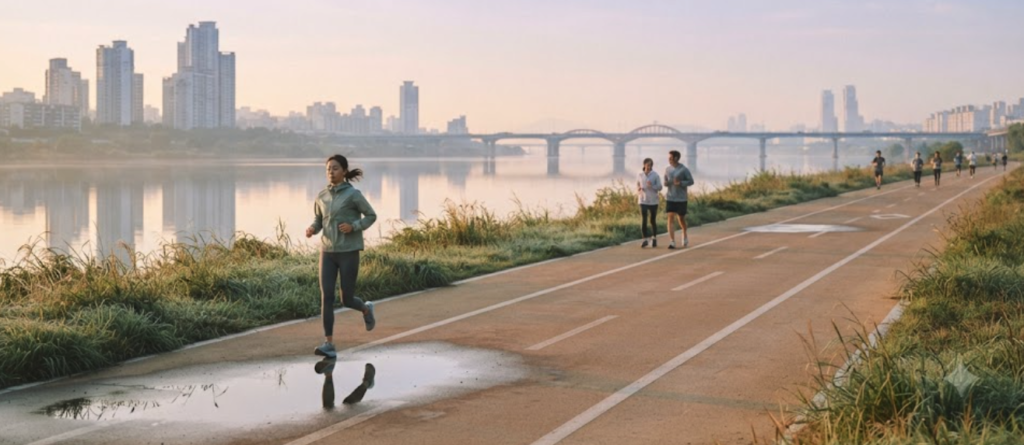
One of the most beautiful things about Han River running is the way people share the space.
You see runners moving at different speeds,
cyclists passing by,
walkers enjoying the breeze,
couples strolling,
friends chatting,
and individuals simply existing.
Nobody interrupts anyone.
Nobody stares.
Nobody judges.
Foreigners often say Han River running feels like “alone together.”
You’re running by yourself,
but you’re surrounded by others who are also choosing movement,
also choosing breath,
also choosing a moment of quiet.
It’s a collective solitude—
a shared ritual that doesn’t require interaction.
The Softness of Night Running
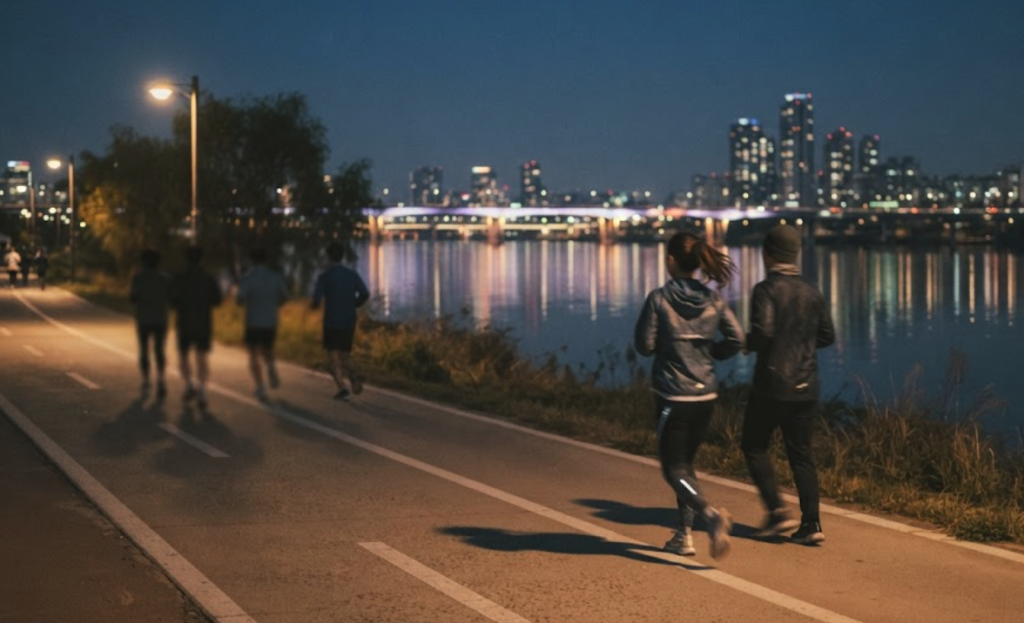
Night running along the Han River is its own culture.
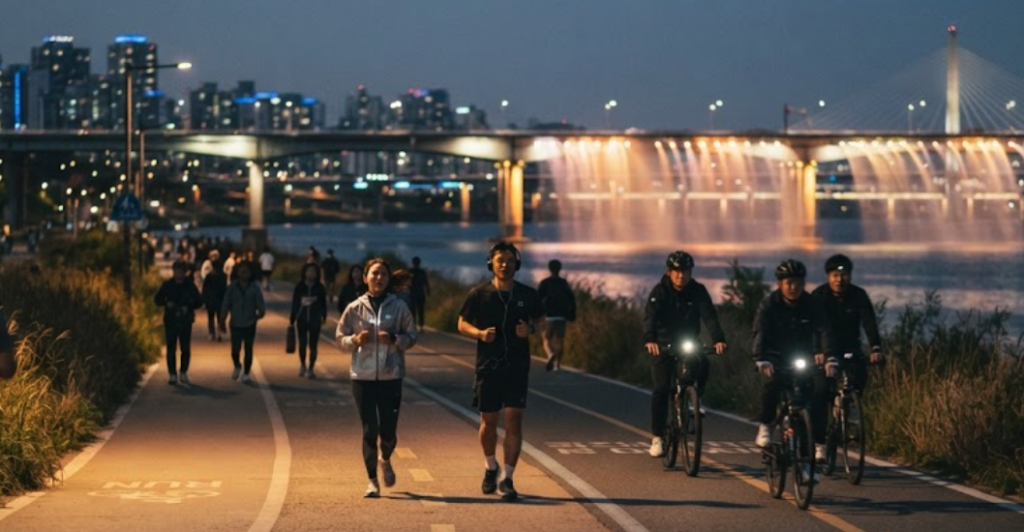
The city lights reflect on the water,
the bridges glow in warm colors,
and the skyline becomes a soft silhouette instead of a sharp outline.
Foreigners often describe night running as “the moment Seoul becomes gentle.”
You pass people jogging with headphones,
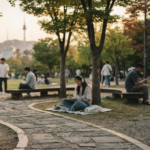
friends sitting on the grass eating convenience-store snacks,
cyclists gliding by with small lights,
and couples lying on picnic mats watching the city breathe.
The river at night doesn’t feel dangerous or empty.
It feels safe, warm, and quietly alive.
Running here at night feels like being part of a secret—
a softer version of Seoul that only reveals itself to those who seek it.
Morning Running: The City Before It Wakes
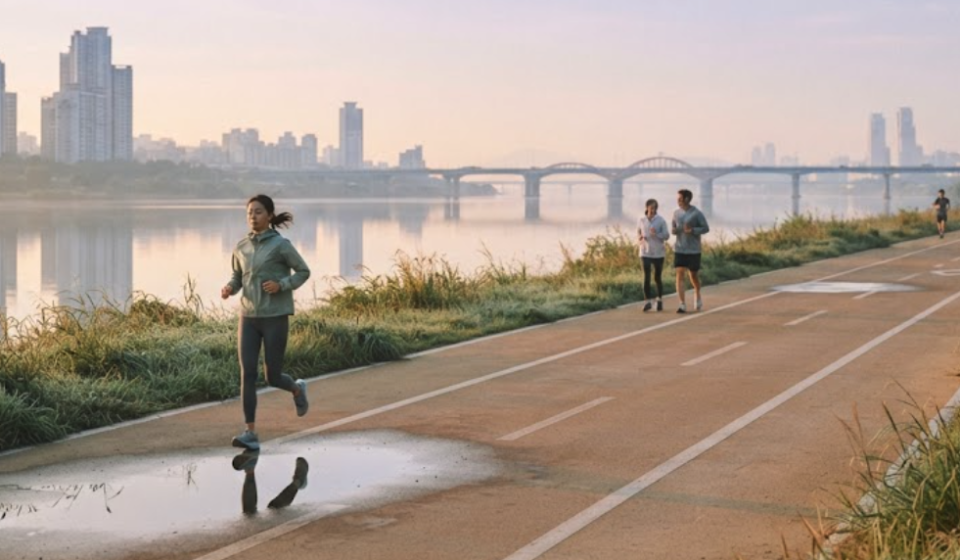
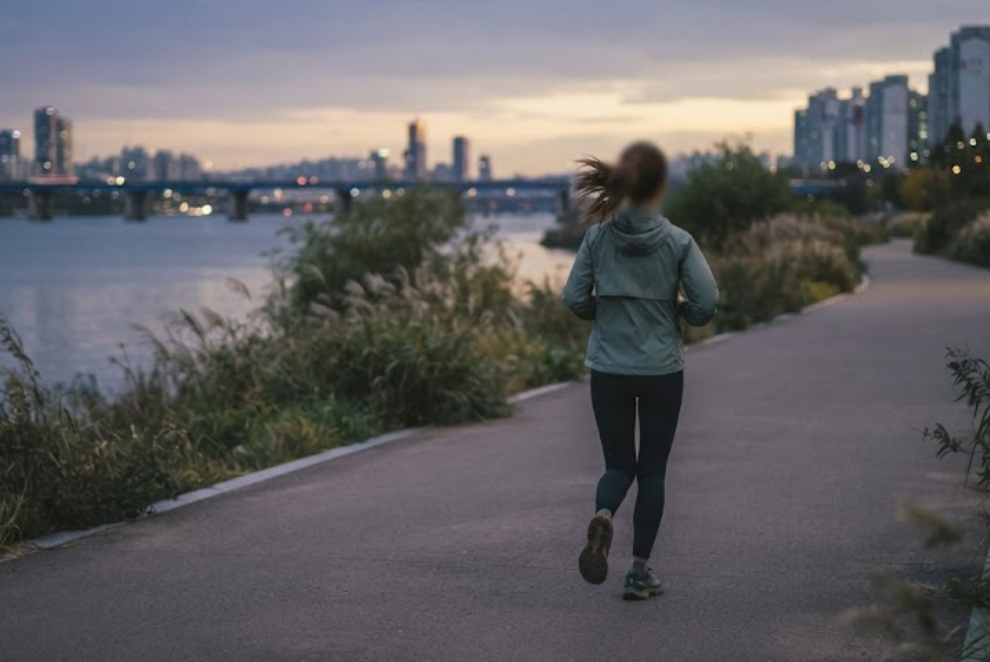
Morning running along the Han River is completely different.
The air is crisp,
the sky pale,
and the city still half asleep.
Foreigners love morning runs because they feel like witnessing Seoul before it puts on its fast-paced mask.
You see elderly neighbors stretching,
office workers jogging before their commute,
and students walking slowly with iced coffee.
The river feels clean,
the paths feel open,
and the city feels gentle.
Morning running is the moment when Seoul feels like a small town—
quiet, familiar, and full of possibility.
Why Running Became a Cultural Movement in Seoul
Running in Seoul isn’t just fitness.
It’s cultural.
Foreigners often ask:
“Why does everyone run here?”
The answer is layered:
Because the city is safe.
Running alone at night feels normal, not risky.
Because the river is accessible.
Paths are wide, clean, well-lit, and beautifully maintained.
Because people value small rituals.
Running becomes a daily moment of peace.
Because Seoulites seek balance.
A fast city needs soft habits.
Because running feels communal without being social.
You’re part of something without needing to participate.
Running along the Han River is a cultural expression of Seoul’s emotional rhythm—
fast but gentle,
busy but warm,
crowded but never lonely.
The Unspoken Etiquette of Han River Running
Foreigners quickly notice the subtle social rules:
People pass quietly.
Cyclists ring their bells softly.
Runners shift lanes without conflict.
Nobody blocks the path.
Nobody intrudes on others’ pace.
Everyone respects the shared space.
It’s a kind of collective awareness—
a quiet choreography that makes running feel smooth and safe.
This etiquette is part of what makes Han River running feel comforting.
You’re alone,
but you’re held by the city’s gentle rules.
Running as a Form of Healing
Many foreigners say running along the Han River helped them adjust to life in Seoul.
It became:
a place to think,
a place to breathe,
a place to feel grounded,
a place to feel connected without needing to talk.
The river becomes a therapist,
a friend,
a companion,
a constant.
Running here feels like letting the city hold you for a moment—
not loudly,
not dramatically,
but softly.
Why Han River Running Never Feels Lonely
Loneliness isn’t about being alone.
It’s about feeling disconnected.
The Han River bridges that gap.
It lets you run alone while feeling part of a shared ritual.
It lets you move independently while feeling surrounded by gentle presence.
It lets you exist quietly among others who are also seeking breath, space, and calm.
Foreigners often say:
“Running along the Han River made Seoul feel like home.”
Not because the city slowed down,
but because the river made solitude feel safe.
The River That Moves With You
Running along the Han River is more than exercise.
It’s a cultural experience.
A soft ritual.
A shared silence.
A moving meditation.
It’s the moment when Seoul feels human,
when the city’s speed softens,
when strangers become companions,
and when solitude becomes comfort.
The Han River doesn’t just flow through Seoul.
It flows through the people who run beside it.
And that’s why running here never feels lonely.
It feels like belonging.
🔗 Recommended External Link
Visit Seoul – Official Seoul Tourism Website (English)
https://english.visitseoul.net